
Table of Contents
- Why BJJ Gi Size Matters More Than You Think
- BJJ Gi Size Chart: What A0 to A6 Actually Mean
- How to Measure for a BJJ Gi: Height, Weight, and Wingspan
- How Much Do BJJ Gis Shrink? Fabric, Weave, and Wash Habits
- Slim, Stocky, or Lanky: Adjusting for Body Type and Gender
- Troubleshooting BJJ Gi Fit Issues: Cuffs, Sleeves, and Inseams
- Frequently Asked Questions
Last Updated: September 23, 2026
Why BJJ Gi Size Matters More Than You Think
Getting your BJJ gi size wrong does more than look sloppy. A gi that's too tight restricts your breathing and limits your guard game. One that's too loose gives opponents extra grips and can get you disqualified in competition.
BJJ Gi Size Chart: What A0 to A6 Actually Mean
The A-series is a height-and-weight bracket system, not a body measurement system. Each number from A0 to A6 covers a range of heights and weights, and the letter suffix (L for long, H for heavy, S for slim) adjusts that bracket for build.
| Size | Typical Height Range | Typical Weight Range | Best For |
|---|---|---|---|
| A0 | 5'0" - 5'4" | 100 - 130 lbs | Smaller adults, teens |
| A1 | 5'4" - 5'8" | 130 - 165 lbs | Average adult frame |
| A2 | 5'8" - 5'11" | 165 - 195 lbs | Most common adult size |
| A3 | 5'11" - 6'2" | 195 - 225 lbs | Larger adult frame |
| A4 | 6'2" - 6'4" | 225 - 255 lbs | Tall and heavy |
| A5 | 6'3" - 6'5" | 255 - 285 lbs | Heavyweight |
| A6 | 6'4"+ | 285+ lbs | Super heavyweight |
How to Read Any BJJ Gi Size Chart
Every brand's chart is a suggestion, and they vary. A common mistake is trusting the weight column alone. If you're 5'10" and 200 lbs, you're at the edge of A2 and A3. Height usually wins that tie, because a gi that's too short in the sleeves is a competition liability.
How to Measure for a BJJ Gi: Height, Weight, and Wingspan
Measuring for a BJJ gi takes about five minutes with a soft tape measure and a training partner. You need three numbers: your height, your weight, and your wingspan, which is the distance from fingertip to fingertip with arms extended horizontally.
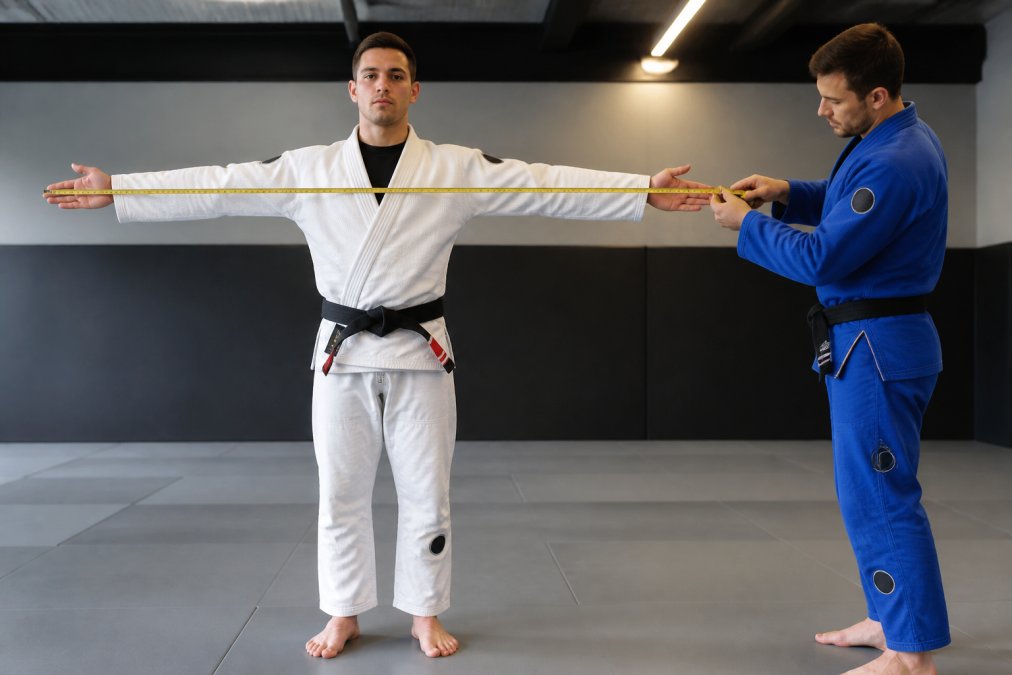
The Three Numbers That Decide Your Size
- Height, Stand against a wall without shoes. This sets your base bracket.
- Weight, Weigh yourself in the morning, before training. This confirms or shifts the bracket.
- Wingspan, Arms straight out to the sides, measured fingertip to fingertip. If your wingspan exceeds your height by more than two inches, you likely need a long (L) variant.
A lanky build with a long wingspan often needs an L size even when the standard bracket fits by weight. A stocky build with a short wingspan may need an H size for extra torso room.
How Much Do BJJ Gis Shrink? Fabric, Weave, and Wash Habits
Most BJJ gis shrink somewhere between one and three inches in length after the first few washes, but that range hides a lot of variation. The weave, the fabric treatment, and your drying routine each move the number, and knowing which one you're dealing with is what lets you buy the right size the first time.
Shrinkage by Weave Type
Weave isn't just a durability choice, it's a shrinkage choice. Tighter constructions move less because there's less slack in the yarn to pull in.
- Single weave: the lightest and most open construction. Typically shrinks the most, often toward the top of the 1-to-3-inch range, and can keep creeping over the first several washes.
- Double weave: heavier and denser, so it shrinks less per wash but holds more water and takes longer to dry. Total movement is usually smaller than single weave.
- Pearl weave: a tight, pebbled construction that resists distortion well. Shrinkage is generally modest and fairly predictable, which is why it's a common competition choice.
- Gold weave: a dense, smooth weave that holds its shape better than single weave but still moves some. Expect less than single, more than a well-treated pearl.
- Hemp and blends: hemp fiber tends to hold its shape through repeated wash cycles better than cotton, so a hemp gi often shrinks less overall and stabilizes faster.
How Wash and Dry Habits Change the Math
Fabric sets the ceiling; your routine decides how close you get to it.
- Cold wash, air dry: minimal additional shrinkage. This is the safest routine and the one to use once a gi fits the way you want.
- Cold wash, tumble dry low: moderate shrinkage. Expect some tightening in the sleeves and pant legs, especially on single weave.
- Warm wash, tumble dry: significant shrinkage. Useful as a deliberate correction when a gi is slightly too big, risky as a default routine.
- Hot wash, hot dry: the most aggressive combination. Reserve it for a gi that's clearly oversized, and check the fit after every cycle.
Sizing Around Shrinkage Before You Buy
If you're between two sizes and you know the gi will shrink, the decision usually comes down to weave and routine:
- Buying a single weave? Size up if you're at the top of a bracket, then plan a controlled warm wash to bring it in.
- Buying a pearl or double weave? You have less margin to work with, so buy closer to your true measurements and keep the wash cold.
- Buying hemp or a pre-shrunk cotton? You can usually buy your true size and skip the shrink-to-fit gamble.
Slim, Stocky, or Lanky: Adjusting for Body Type and Gender
The A-series was built around a single reference body, and almost nobody matches it exactly. The gap between the chart and your actual frame is where fit problems live, so it helps to know which dimension each variant actually changes.
What the L, H, and S Suffixes Really Change
- L (long): adds sleeve and pant length, roughly 1 to 2 inches, without widening the torso. Built for practitioners whose wingspan or leg length outruns their height bracket.
- H (heavy): adds torso and thigh circumference without adding much length. Built for stocky, dense builds that sit at the top of a weight bracket.
- S (slim): narrows the jacket body and sleeve opening while keeping the same length. Built for lean frames that swim in a standard cut.
A common pattern is a practitioner who lands in A2 by weight but needs A2L because their arms hang past the standard sleeve. Another is an A3 by height who needs A3H because their chest and thighs won't clear the standard jacket.
Sizing for Women
Most A-series charts are cut for a male torso: straighter through the waist, wider at the shoulders, and longer in the jacket body. Women often find that a gi matching their height and weight still gaps at the waist, rides up in the jacket, or leaves the pants sitting too high or too low.
Practical adjustments that tend to work:
- Size the jacket and pants separately when a brand allows it. Many women need a smaller jacket than pants, or the reverse, and a mixed set beats a single mismatched size.
- Check the pants rise and inseam, not just the waist. Women's cuts frequently use a different rise, and a standard men's pant can sit uncomfortably high or bind at the hip during guard work.
- Watch the jacket length. A jacket cut for a longer male torso can hang past the hips on a shorter female frame, which changes how it moves when you're on the bottom.
- Consider a women's-specific cut if the brand offers one. These adjust shoulder width, waist taper, and jacket length together rather than forcing you to compromise on one dimension.
Quick Body-Type Reference
| Build | Likely Issue | First Adjustment |
|---|---|---|
| Lanky, long wingspan | Sleeves and pants too short | Try the L variant in your bracket |
| Stocky, short wingspan | Torso and thighs too tight | Try the H variant in your bracket |
| Lean, narrow frame | Jacket and sleeves too baggy | Try the S variant or size down |
| Female, average height/weight | Waist gap, jacket too long, pant rise off | Split jacket/pants sizing; check women's cuts |
Troubleshooting BJJ Gi Fit Issues: Cuffs, Sleeves, and Inseams
Fit problems usually show up in three places: the cuffs, the sleeves, and the inseam. Each has a specific fix, and each has a competition rule attached.
Frequently Asked Questions
What size gi for someone who is 5'10"?
At 5'10", most BJJ gi size charts place you in an A2 or A2L, depending on weight and build. If you weigh between 165 and 190 pounds with a balanced frame, A2 usually fits. If you are leaner with longer arms, A2L adds sleeve and pant length without extra width. Always check the specific brand's BJJ gi size chart, because a BJJ gi size varies between makers.
What does an A1, A2, or A3 gi size actually mean?
The A-series is a height-and-weight bracket system, not a universal number. A0 fits smaller adults, A1 covers roughly 5'2" to 5'7", A2 covers about 5'6" to 5'10", and A3 covers about 5'9" to 6'1". Each step up adds width and length. Two brands can label the same body as A2 and still fit differently, so use the chart plus your own measurements.
Do BJJ gis shrink after the first wash?
Yes, most gis shrink, and the first wash causes the biggest change. Cotton pearl weave can lose 3 to 5 percent in length, and gold weave often shrinks slightly less. Pre-shrunk fabric loses less. Cold wash and air dry keep shrinkage under control. If you tumble dry on high heat, expect the jacket and pants to shorten noticeably, sometimes enough to drop you out of competition legal cuff length.
Should I size up or down when buying a BJJ gi?
Size up if you are at the top of a weight bracket, have a stocky build, or plan to tumble dry. Size down only if you are at the bottom of a bracket and want a tight competition fit. For training, a slightly loose fit is safer because it allows full range of motion and leaves room for shrinkage. When in doubt, order your measured size and use the brand's exchange policy.
How do I measure my wingspan for a gi?
Stand with arms straight out to the sides, parallel to the floor. Have someone measure from the tip of one middle finger to the tip of the other. Compare that number to the sleeve length on the BJJ gi size chart. A wingspan longer than the chart's range for your height means you need a long cut, such as A2L or A3L. Short wingspan means a regular cut fits better.
How can I tell if my BJJ gi is too big or too small?
Check three points. The jacket cuff should sit at or just above the wrist bone when your arm is extended. The pants should reach the top of the foot without dragging. The jacket skirt should cover your hips when the lapels are closed. If the cuffs fall past your knuckles, the gi is too big. If you cannot close the jacket without pulling, it is too small.
Do men and women need different BJJ gi sizes?
The A-series is unisex, but body shape matters more than the label. Women often need a smaller jacket size with a longer inseam, or a cut designed with a narrower waist and shorter sleeves. Some brands offer female-specific cuts. Measure your hips, waist, and wingspan, then compare against the brand's chart rather than assuming your usual A-size will fit.